Documentation Index
Fetch the complete documentation index at: https://support.wepayments.com.br/llms.txt
Use this file to discover all available pages before exploring further.
WEpayments maintains and cross-references multiple restrictive lists as part of our compliance framework. This guide explains what these lists are, how screening works, and how restrictive lists impact transaction processing.
What are restrictive lists?
Restrictive lists are databases of entities that are subject to sanctions, regulatory restrictions, or enhanced due diligence. WEpayments screens all transactions and account holders against these lists to ensure compliance with Brazilian and international regulations.
Types of restrictive lists
| List type | Description |
|---|
| Sanctions lists | OFAC, UN, EU, and Brazilian government sanctions |
| PEP lists | Politically Exposed Persons and their close associates |
| Internal blacklists | Entities previously flagged within WEpayments |
| Watchlists | Regulatory and law enforcement watchlists |
| Negative media lists | Entities associated with adverse news |
| Adverse media screening | Negative news and public records |
💡 Screening applies to both Payin (incoming) and Payout (outgoing) transactions, as well as account onboarding.
What is a PEP (Politically Exposed Person)?
A PEP is an individual who occupies or has occupied prominent public or political positions, as well as their family members and close associates.
Examples of PEPs
| Category | Examples |
|---|
| Domestic PEPs | Presidents, ministers, senators, judges, governors, mayors |
| Foreign PEPs | Equivalent positions in other countries |
| International organization PEPs | Senior officials of UN, IMF, World Bank, etc. |
| Family members | Spouse, partner, parents, children |
| Close associates | Business partners with known close relationship |
⚠️ PEP status applies for 5 years after the person leaves office.
How screening works
Screening triggers
| Trigger | When it happens |
|---|
| Account onboarding | When a new merchant or beneficiary is registered |
| Transaction processing | Each transaction is screened in real-time |
| Periodic re-screening | Existing accounts are re-screened periodically |
| List updates | When restrictive lists are updated |
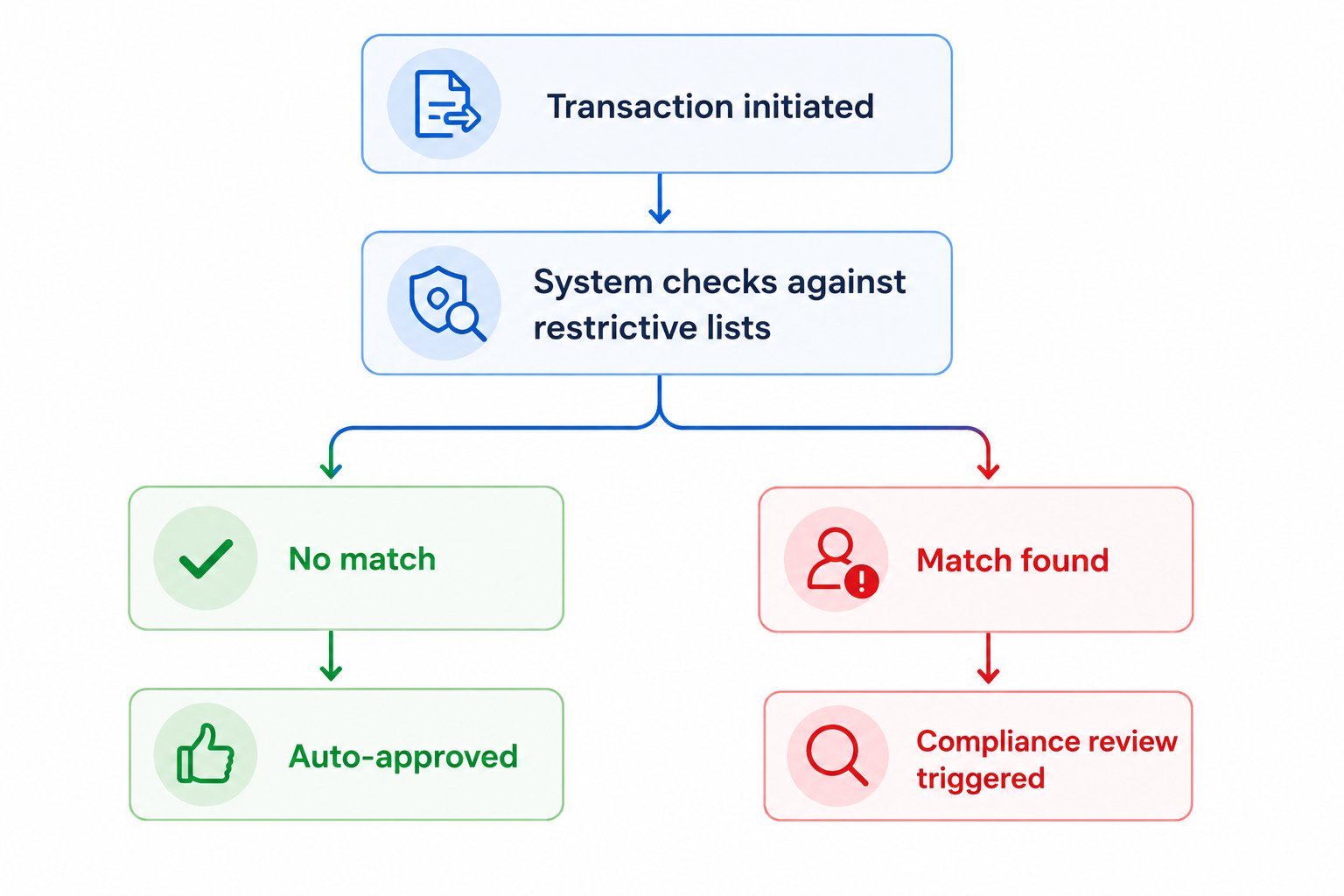
Screening process
Impact of restrictive lists on transactions
| Outcome | Description | What happens |
|---|
| No match | Transaction proceeds normally | Auto-approved |
| Potential match | System flags for manual review | Compliance team analyzes |
| Confirmed match | Entity is on a restrictive list | Transaction blocked |
| PEP match | Enhanced due diligence required | Additional documentation needed |
Automatic blocking
Transactions involving entities on sanctions lists or internal blacklists are automatically rejected. The transaction will not proceed under any circumstances.
Manual review
For potential matches or PEPs, the compliance team conducts a manual analysis to determine if the transaction can proceed.
False positives and appeals
What is a false positive?
A false positive occurs when a transaction is flagged as a potential match but the entity is not actually on a restrictive list (e.g., name similarity).
How to handle a false positive
| Step | Action |
|---|
| 1. Notification | You receive notification that a transaction is under review |
| 2. Documentation | Submit documentation demonstrating no violation exists |
| 3. Analysis | Compliance team reviews the documentation |
| 4. Release | If confirmed as false positive, transaction is released |
Appeal process
If you believe a transaction was incorrectly blocked, you can:
- Contact our compliance team
- Provide supporting documentation
- Request a review of the decision
💡 False positives are rare but can happen. We work to minimize them while maintaining rigorous compliance standards.
Restricted business categories
Some business categories are subject to enhanced screening or are not permitted. Examples include:
| Category | Treatment |
|---|
| Gambling | High risk – enhanced due diligence required |
| CBD / medicinal cannabis | Permitted with specific documentation (see Cross-Border section) |
| Intercompany payments | Not permitted under eFX (see Cross-Border section) |
| High-risk jurisdictions | Enhanced screening applies |
💡 Contact our compliance team to verify if your business category is permitted.
Your responsibilities
| Responsibility | Description |
|---|
| Accurate KYC | Provide complete and accurate information during onboarding |
| Update changes | Notify WEpayments of any changes to beneficial ownership or corporate structure |
| Respond promptly | Answer compliance requests quickly to avoid delays |
| Maintain records | Keep documentation of business relationships and transactions |