With the new Automatic Conversion Fee feature, charges related to crossborder operations are now automatically calculated and registered directly within the transactional flow and the ledger. The goal of this functionality is to provide more transparency, predictability, and traceability for fees associated with international transactions.
How the fee works
The Conversion Fee is configured as a percentage and applied to the gross transaction amount.
When configured:
the fee is automatically calculated
the amount is registered in the ledger
the fee remains linked to the original transaction
Which transactions can generate a Conversion Fee
The feature applies to eligible crossborder operations, including:
Payin
Payout
Returns and reversals
Supported categories include:
PIX
Card
Boleto
TED
Reversals and refunds
How the fee appears in the ledger
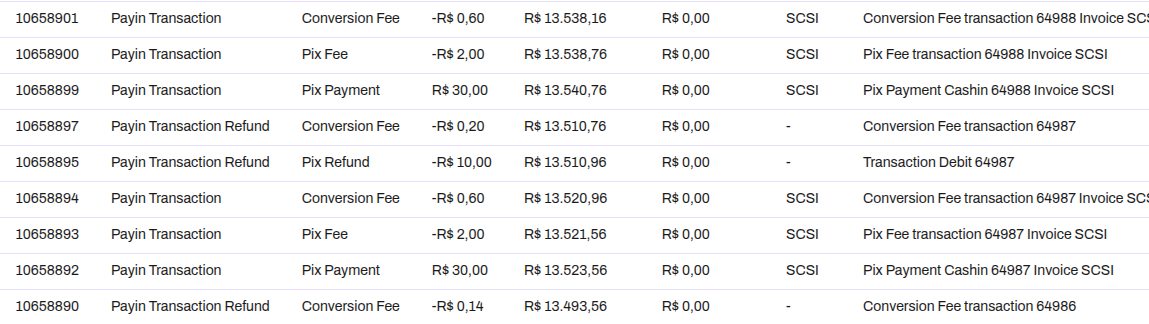
With the new functionality, a transaction can generate up to three ledger entries:
Main transaction (e.g. PIX Payment)
Operational fee (e.g. PIX fee)
Conversion Fee (e.g. Conversion fee)
All generated entries maintain reference to the original transaction, ensuring traceability in statements and reconciliation processes.
Balance impact
The fee behavior varies depending on the transaction type.
Payin
For incoming transactions:
the Conversion Fee is debited immediately after the transaction credit
the impact occurs directly on the available balance
Payout
For outgoing transactions:
the system validates whether there is enough balance to cover the fee
the fee is only charged after the transaction is successfully completed
in case of failure, no amount is debited
How the amount is calculated
The Conversion Fee is calculated based on the gross transaction amount, according to the values agreed upon in the contract:
Conversion Fee = transaction_amount × fee_percent
When configured, the fee and IOF amounts (when applicable) are combined and reflected as a single charge in the ledger.
More control for crossborder operations
The automation of the Conversion Fee represents another step in the evolution of the crossborder financial infrastructure, providing greater operational control, predictability, and transparency for clients and internal teams.
By integrating the fee directly into the transactional flow, the process becomes more consistent, auditable, and scalable.
In addition, the fee structure simplifies reconciliation processes and makes the financial operation less complex within the crossborder ecosystem.