Documentation Index
Fetch the complete documentation index at: https://support.wepayments.com.br/llms.txt
Use this file to discover all available pages before exploring further.
Cross-border operations allow international companies to pay suppliers, employees, and partners in Brazil efficiently and in compliance with local regulations. This guide explains how these payments work, the role of PIX, and the required documentation flow.
How cross-border payments to Brazil work
If you are an international company making payments to Brazilian recipients (suppliers, freelancers, employees, or service providers), you need a payment service provider authorized to operate in Brazil – such as WEpayments.
Typical use cases
| Use case | Examples |
|---|
| Supplier payments | Marketing agencies, technology providers, logistics companies |
| Employee payments | Remote workers, local representatives, payroll |
| Service provider payments | Consultants, freelancers, legal services |
| Affiliate payments | Commission payouts to Brazilian partners |
Can I use PIX to make an international payment to Brazil?
Yes, but with a partner like WEpayments.
| Key points | Details |
|---|
| PIX always in BRL | Payments via PIX are always processed in Brazilian reais |
| Direct foreign accounts | You cannot link a foreign bank account directly to PIX |
| Solution | Use a specialized provider (e.g., WEpayments Payout) to convert and send funds via PIX |
| How it works | WEpayments receives your foreign currency, converts to BRL, and sends via PIX to the Brazilian beneficiary |
💡 PIX is the fastest way to pay beneficiaries in Brazil – 24/7, instant settlement.
Required documentation for cross-border payments
Whenever you make a payment to a Brazilian company (PJ account), documentation must be provided before the payment is completed.
Documents required per transaction
| Document | Description |
|---|
| Nota Fiscal | Brazilian tax invoice from the receiving company |
| Invoice | Commercial invoice from the paying foreign company |
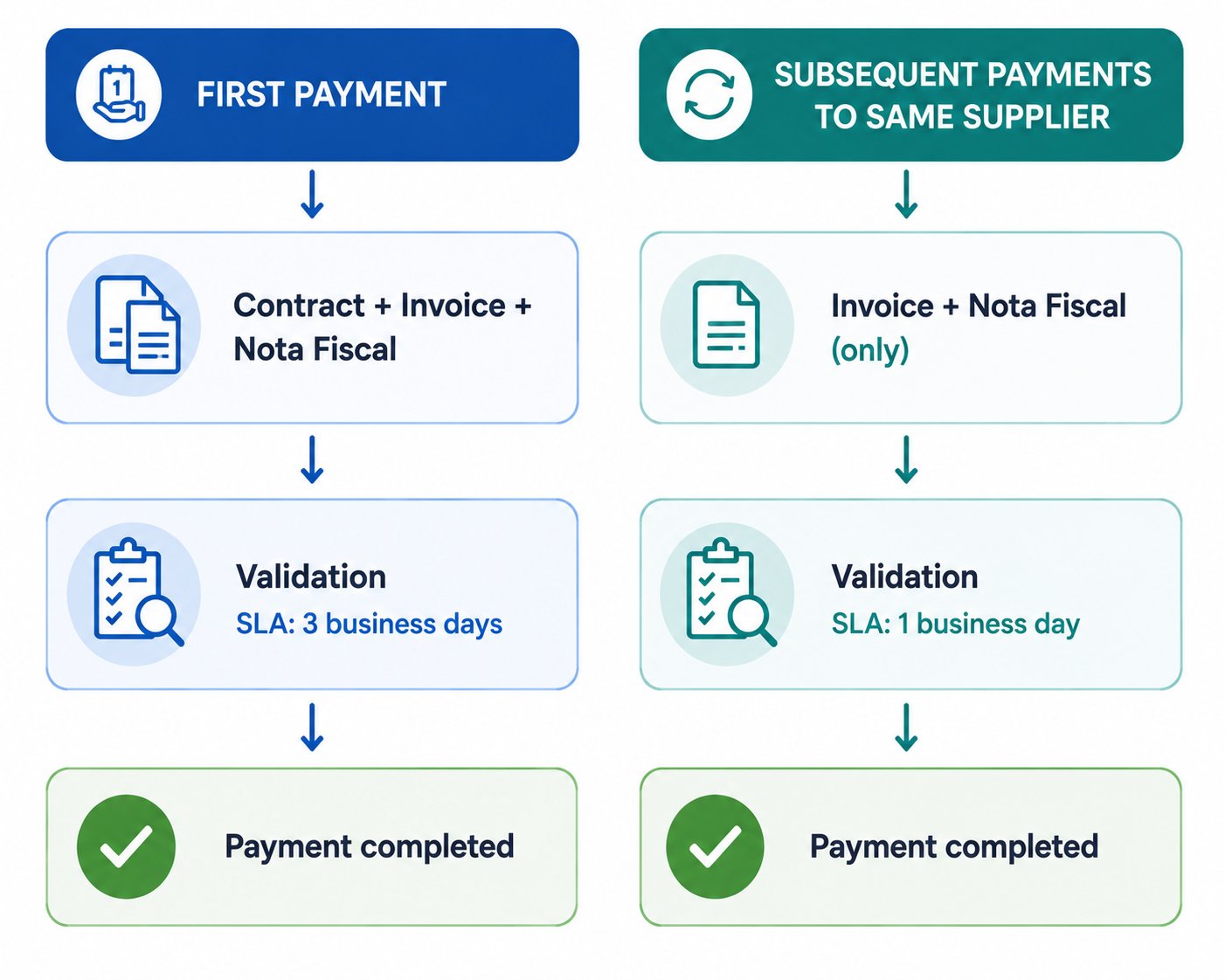
Documents required on first transaction with each supplier
| Document | Description | Reusable? |
|---|
| Commercial contract | Agreement between the parties | Yes – for future payments |
Documentation flow
⚠️ Important: The invoice and Nota Fiscal must have the same amount as the payment. Partial payments must be clearly described as installments.
Document requirements for partial payments
If your invoice has a fixed total amount but you are paying in installments:
| Requirement | Example |
|---|
| Invoice description | ”Total amount R10,000–payment1of5:R10,000–_payment_1_of_5:R 2,000” |
| Nota Fiscal description | Same as invoice, clearly indicating which installment |
What happens after document submission?
| Step | Description |
|---|
| 1. Documents submitted | You attach documents when creating the transaction |
| 2. Validation | Compliance team analyzes information against regulatory requirements |
| 3. Approval | If correct, payment is processed |
| 4. Completion | Beneficiary receives funds |
Why is this process important?
International payments to Brazilian companies require documentary proof per transaction for regulatory compliance.
Benefits of following the process
| Benefit | Description |
|---|
| Compliance | Operations meet applicable regulatory requirements |
| Predictability | Payments occur with clear timelines |
| Organization | Information is easy to track and consult |
| Security | Safeguards throughout the operation |
Important restrictions (BCB Resolution nº 561/2026)
Due to BCB Resolution nº 561/2026, intercompany payments (where the paying and receiving companies share the same corporate structure) are not permitted under the eFX model.
Why intercompany payments are restricted
| Reason | Explanation |
|---|
| eFX purpose | Intended for specific transactions like purchase of goods/services or unilateral transfers |
| Intercompany characterization | Payments between companies with shared ownership may be interpreted as capital transfers or loans – purposes not allowed in this model |
| Regulatory solution | Intercompany operations must use the traditional FX market, which allows proper classification and is not subject to eFX value limitations |
What this means for you
- Ensure the Brazilian receiving company does not share corporate structure with the paying foreign company
- If intercompany payments are necessary, contact support to explore traditional FX alternatives
Template resources
WEpayments provides:
- Standardized invoice template – available in the article or via invoice generator
- Nota Fiscal example – to facilitate your documentation process